The Kentucky Foreclosure Timeline: What Actually Happens, and When
You missed a payment. Then another one. Now there’s a letter on the counter you haven’t opened, and the question running through your head at 2 a.m. is simple: how much time do I have left?
Nobody gives you a straight answer. The Kentucky foreclosure timeline gets described online in vague ranges — “about five months,” “six to twelve months,” “it depends” — and none of that tells you what you need to know. Which is this: at every stage there’s a door still open, and a date when it closes.
Here’s the sequence, stage by stage, the way it runs in Jefferson County. What your lender can do, what the court does, what the Master Commissioner does, and the exact moment your ability to sell goes away.
This article explains general process and is not legal or tax advice. Talk to a Kentucky attorney or tax professional about your specific situation.
Key Takeaways
- Kentucky is a judicial foreclosure state. Your lender has to sue you in circuit court and win. Nobody can take your house with a letter.
- In most cases federal law stops your servicer from filing the lawsuit until you’re more than 120 days past due (12 C.F.R. § 1024.41).
- Once you’re served, you have 20 days to file an answer. Missing that is what turns a slow case into a fast one.
- You can sell the house right up until the auction gavel falls. Filing, judgment, even a scheduled sale date — none of those take away your right to sell and pay off the loan.
- The six-month “right of redemption” people talk about only exists if the house sells at auction for less than two-thirds of its appraised value (KRS 426.530). Most of the time, it doesn’t apply.
Why the Kentucky Foreclosure Timeline Confuses So Many Louisville Homeowners
Two things make this hard to pin down.
First, half the timeline is federal and half is Kentucky. The early stages — late fees, collection calls, the breach letter, the 120-day waiting period — run on your mortgage contract and federal servicing rules. The moment a lawsuit gets filed, it switches to Kentucky procedure and Jefferson Circuit Court’s calendar.
Second, the parts that vary most are the parts people ask about. How fast the court moves depends on whether you respond, whether the lender’s paperwork is clean, and how busy the docket is. So writers hedge, and you get “five to twelve months,” which is not a plan.
The fixed parts are the ones worth memorizing: the 120 days, the 20 days, and the two-thirds rule. Those don’t move.
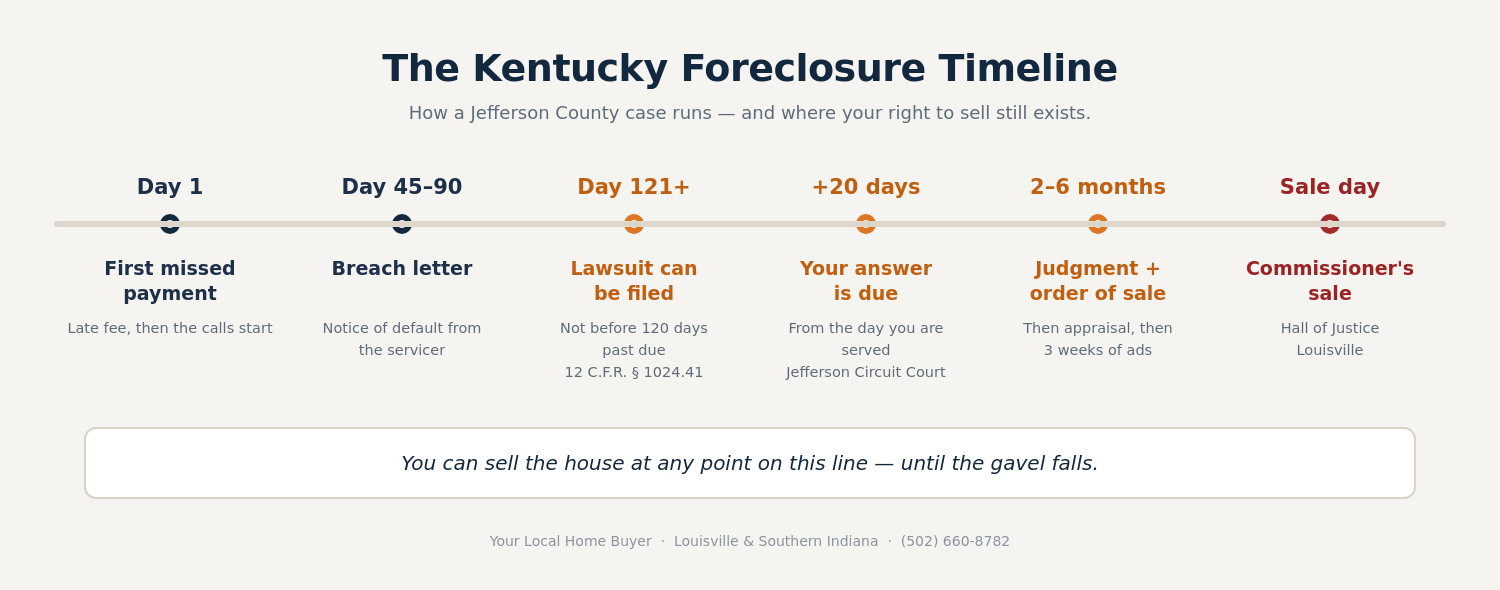
Every stage below the line is a stage where you can still sell the house.
The Kentucky Foreclosure Timeline, Stage by Stage
Here is the whole sequence in one place. The last column is the one most articles leave out.
| Stage | Who acts | Typical timing | Can you still sell? |
|---|---|---|---|
| First missed payment | You and the servicer | Day 1 | Yes |
| Late fee, then collection calls | Servicer | Days 16–45 | Yes |
| Breach letter / notice of default | Servicer | Roughly day 45–90 | Yes |
| Earliest the lawsuit can be filed (12 C.F.R. § 1024.41) | Servicer | Day 121 or later | Yes |
| Complaint filed, summons served, lis pendens recorded | Jefferson Circuit Court | Filing day | Yes |
| Your written answer is due | You | 20 days after service | Yes |
| Default or summary judgment, and the order of sale | Judge, on the Master Commissioner’s recommendation | Often 2–6 months after filing | Yes |
| Two appraisers do a drive-by appraisal (KRS 426.200) | Master Commissioner’s office | After judgment | Yes |
| Notice of sale posted at the property and advertised three times | Master Commissioner (KRS 424.130) | The three weeks before the sale | Yes |
| The sale | Master Commissioner, Hall of Justice | Sale day | No. This is the door closing. |
| Sale report filed, then 10 days for objections | Master Commissioner and the court | Within 3 business days, plus 10 days | No |
| Redemption window — only if the bid was under two-thirds of appraised value | You (KRS 426.530) | 6 months from the sale | You can buy it back, not sell it |
| Purchaser takes possession | Purchaser (KRS 426.260) | 10 days’ notice, then a writ | No |
The first 120 days. Federal servicing rules generally bar your servicer from making the first foreclosure filing until the loan is more than 120 days delinquent. There are exceptions. But for most Louisville homeowners, four months pass between the first missed payment and anything landing in court. That is time to use, not time to wait out.
The complaint and the summons. Kentucky is judicial. Your lender files a complaint in Jefferson Circuit Court and has you served, and a notice of the pending action gets recorded against the property so anyone pulling title can see it.
The 20 days. From the day you’re served, you have 20 days to file a written answer. If you don’t, the lender moves for default judgment, and in Jefferson County the Master Commissioner reviews that motion and sends the judge a recommendation. No answer usually means a much shorter case.
Judgment and the order of sale. If the judge signs, the case goes back to the Commissioner’s office to be set for sale. Two appraisers do a drive-by appraisal. Then the sale is advertised — posted at or near the house, and run in the paper three times in the three weeks before the auction.
The sale itself. Sales are held by the Jefferson Circuit Court Commissioner at the Hall of Justice on West Jefferson Street. Properties sell as-is, with no warranty of title. The sale report is filed within three business days, and the sale then sits for ten days so objections can be made.
The Three Numbers That Decide How Much Time You Really Have
120. The days of delinquency before the first filing, in most cases. This is the quietest, most useful stretch of the whole process, and it’s the one people spend not opening mail.
20. The days to answer the complaint. Answering doesn’t make the debt go away, but it puts the case on a litigation track instead of a default track, and that is often the difference between a sale in a few months and a sale much later. If you can’t afford a lawyer, the Kentucky Homeownership Protection Center (866-830-7868) is a free state-run resource that connects homeowners with HUD-approved counselors.
Two-thirds. This is the one almost nobody in Louisville explains correctly. Under KRS 426.530, you only get a right of redemption if the property sells at auction for less than two-thirds of its appraised value — the value set by those two court-appointed appraisers. If the bid clears two-thirds, there is no redemption period at all. When it does apply, you have six months from the day of sale, and you have to pay the purchase price plus 10% per year interest plus what the purchaser has spent maintaining the place.
So the honest version is this: for a lot of homeowners, the auction is the end. Not the beginning of a redemption year.
What Gets Repeated About Kentucky Foreclosure That Isn’t True
“There’s a 37-day foreclosure rule in Kentucky.” There isn’t. Kentucky gives you 20 days to answer a complaint. The number 37 appears on a few real estate blogs and has no basis in Kentucky civil procedure. If you’re counting on 17 extra days that don’t exist, you’ll miss your answer date.
“You get a year to buy the house back.” Kentucky’s redemption period was shortened to six months, effective July 15, 2016. Some long-standing consumer pages — including the state’s own homeowner-help site — still describe it as one year. Read KRS 426.530 or ask an attorney rather than relying on a page that hasn’t been updated.
“Once they file, it’s over.” This is the belief that costs Louisville homeowners the most, and it’s flatly wrong. A foreclosure lawsuit doesn’t transfer your house. You still own it, you can still list it, and you can still sell it — right up until the Commissioner’s sale. A sale that pays off the loan ends the foreclosure.
“Once the house is auctioned, at least the debt is gone.” Not necessarily. If the house brings less than what’s owed, Kentucky allows the lender to pursue a deficiency judgment for the difference.
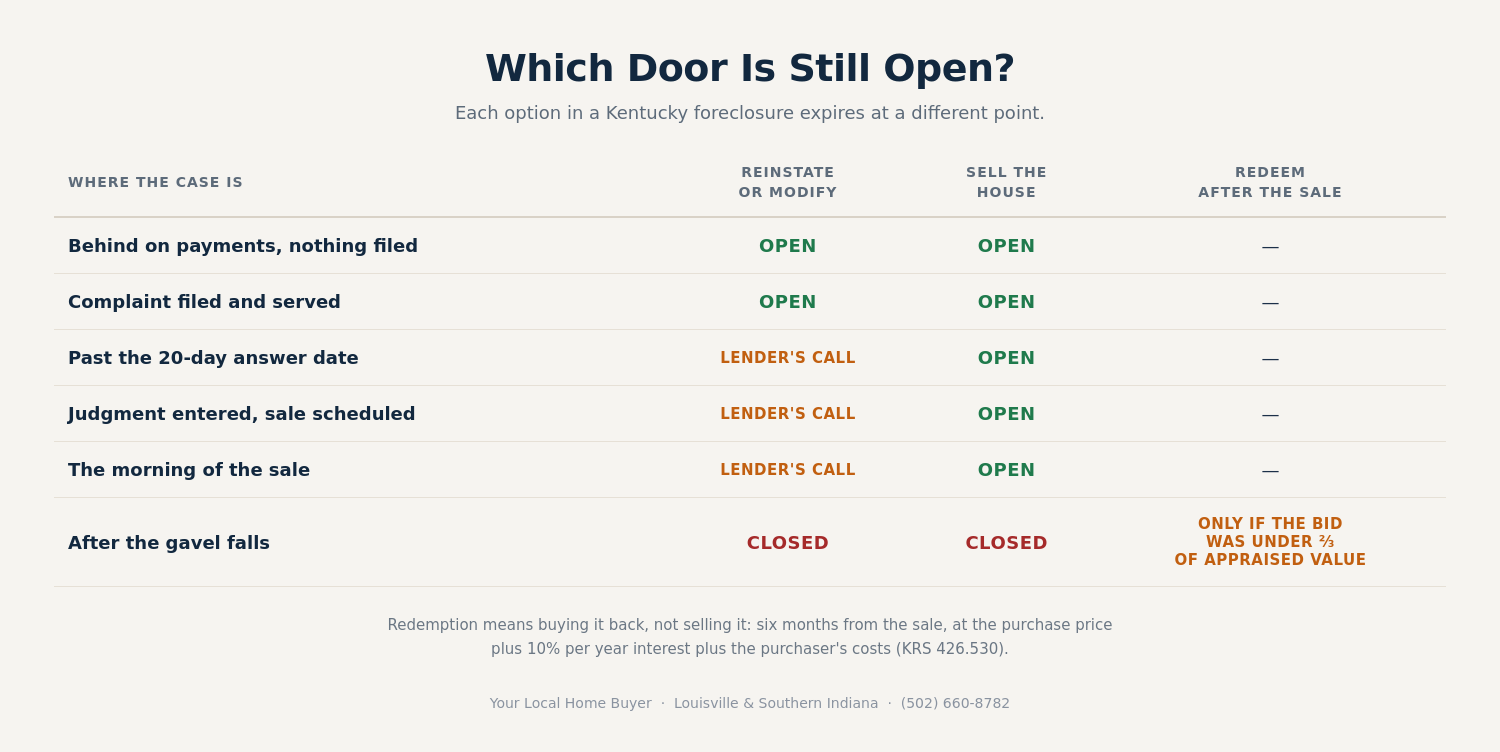
Reinstating, selling, and redeeming all have different expiration dates.
What You Can Actually Do at Each Stage — Including the Options That Don’t Involve Us
We buy houses for cash. That is not the right answer for everyone reading this, and it would be a lousy article if we pretended otherwise.
Reinstate the loan. Pay the missed payments, fees, and costs, and the loan goes back to current. Kentucky doesn’t give a general statutory right to reinstate, but most standard mortgage contracts do. Check yours, or ask the servicer for a reinstatement quote in writing.
Apply for loss mitigation. A loan modification, a repayment plan, or forbearance can stop a foreclosure before it starts. This is what the 120-day window is for. The CFPB publishes plain-English guidance on what your servicer has to do with your application.
Get free counseling. The Kentucky Homeownership Protection Center connects homeowners with HUD-approved counselors at no charge. If there’s a path to keeping the house, they’ll find it faster than you will alone.
List with an agent. If you have real equity, the house shows well, and there’s runway before a sale date, the open market will usually pay you more than we will. Commissions and repairs come out of that, and it takes time you may not have — but if you have the time, take it. That’s the honest math.
Short sale. If you owe more than the house is worth, the lender may agree to accept less than the full payoff. It’s slower, and it depends entirely on the lender saying yes.
Deed in lieu of foreclosure. Hand the deed back and walk away. You give up any equity, but you may avoid the judgment.
Bankruptcy. Chapter 13 can let you catch up on arrears over time, and the automatic stay halts a scheduled sale. Talk to a bankruptcy attorney about whether it fits.
Sell as-is for cash. Best fit when the clock is short, the house needs work you can’t fund, and you’d rather have a clean closing than a maximum price.
How Selling As-Is for Cash Fits Into the Kentucky Foreclosure Timeline
Here’s the trade-off, stated plainly: we pay less than a fixed-up house would bring on the open market. We take on the repairs, the carrying costs, and the risk that the house has problems nobody has found yet. That’s what the discount buys you — certainty and speed.
What it can do inside a foreclosure is close before the sale date. No lender underwriting the purchase, no appraisal contingency, no financing that falls through in week five. We pay off the mortgage and the recorded liens at closing through the title company, the case gets dismissed, and anything left over is yours.
No repairs, no cleaning, no showings. No agent commissions and no fees, and we cover standard closing costs. When it works, it’s because the calendar cooperated — so the earlier in the Kentucky foreclosure timeline you call, the more room there is to work with.
If the auction is days away, be straight with us about that on the first call. Sometimes there’s still time. Sometimes there isn’t, and we’ll tell you so.
What Working With Our Team Looks Like
One conversation. You tell us about the house and where the case stands. We’ll ask for the case number if you have it, so we can see the real sale date instead of guessing.
A written cash offer. Usually within 24 hours of reviewing the details. It’s free, with no obligation attached. Take it to your attorney or your counselor and compare it against your other options — we’d rather you did.
You pick the closing date. We can close in as little as 7–10 days when the title is clean. If you need longer, you take longer. Here’s how we buy houses, and what our neighbors say about working with us.
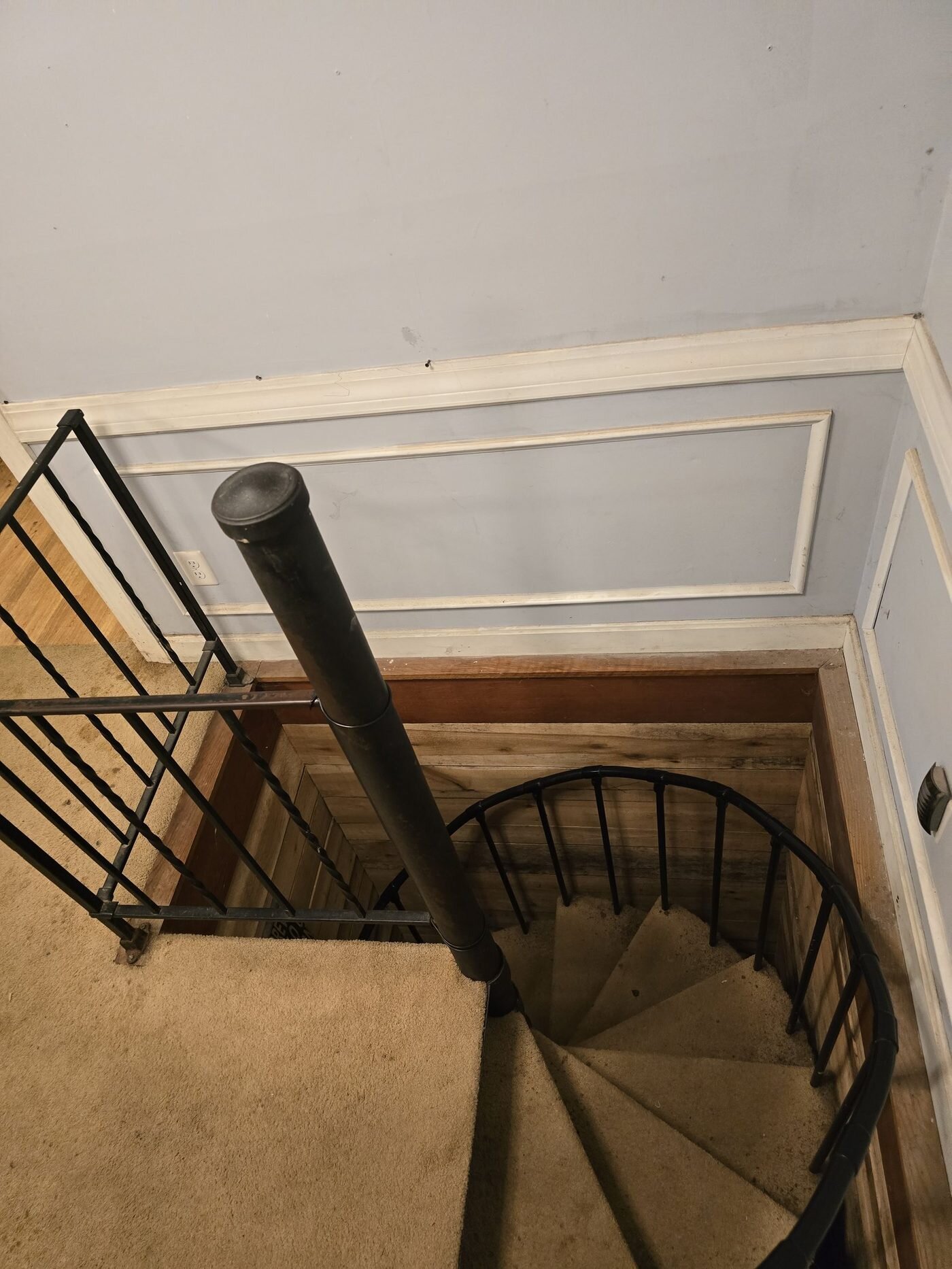
Worn carpet and a 1970s stair rail don’t have to be fixed before you sell.
Louisville, Jefferson County, and the Indiana Side
Foreclosure sales for Jefferson County properties are held by the Circuit Court Commissioner at the Hall of Justice downtown, and the upcoming sale list is public. If a date has been set for your house, it’s on that list — and so is the appraised value the two appraisers came back with. Look it up. It tells you whether a redemption right is even on the table.
The same statutes run in Shively, St. Matthews, Fern Creek, Valley Station, Okolona, and in Oldham, Bullitt, and Shelby counties. The circuit court changes; the deadlines don’t. See the Louisville page for the neighborhoods we work in most.
Across the river, none of this applies. Indiana has its own foreclosure statute and its own settlement-conference process. If your house is in Jeffersonville, Clarksville, or New Albany, don’t plan off a Kentucky timeline.
Common Questions About Foreclosure in Kentucky
How long does foreclosure take in Kentucky from the first missed payment?
For most homeowners, roughly four months pass before the lawsuit can even be filed, and then the court case typically runs several more months. Cases where nobody answers the complaint move faster. Cases that are defended move slower.
Can I sell my house after the foreclosure lawsuit is filed?
Yes. You own the house until the Commissioner’s sale. A closing that pays off the loan and the recorded liens ends the case. The practical limit is the calendar, not your legal right.
Can I sell my house after the auction?
No. Once the property is sold at the Commissioner’s sale, selling is off the table. If the winning bid came in under two-thirds of the appraised value, you may have a six-month right to redeem it — but that means buying it back, and it requires the purchase price plus interest and the purchaser’s costs.
How long do I have to move out after a Kentucky foreclosure sale?
The purchaser is entitled to possession after giving you ten days’ notice, and can then get a writ of possession from the court (KRS 426.260). It is not immediate, and it is not a police officer at the door the next morning.
Will I still owe money after the house is sold at auction?
Possibly. If the sale brings less than the total debt, Kentucky permits the lender to seek a deficiency judgment for the shortfall. This is one of the reasons a sale before the auction can be worth doing.
Do I need to fix the house or clean it out before you’ll buy it?
No. We buy as-is, in any condition. Leave what you don’t want — the junk, the appliances, the stuff in the basement. That’s ours to deal with.
Does filing bankruptcy stop a foreclosure sale in Kentucky?
The automatic stay stops a scheduled sale when the case is filed, and Chapter 13 can give you a structured way to catch up on arrears. Whether it’s the right move depends on your income and your other debts, which is an attorney’s question, not ours.
What to Do Next
Find out where your case actually stands. If you’ve been served, count 20 days from the day of service and put that date on the fridge. If a sale is scheduled, the Commissioner’s sale list has the date and the appraised value.
Then pick a lane. Counseling and loss mitigation if you want to keep the house. An agent if you have equity and time. Us if the clock is short and the house needs more than you can put into it.
To see what a cash sale looks like against your deadline, tell us about the property or call the office at (502) 660-8782. No obligation. If selling to us isn’t your best move, we’ll say so.
The Short Version
The Kentucky foreclosure timeline is longer than most people fear and shorter than most people plan for. Two deadlines genuinely matter — the 20 days to answer, and the day of the Commissioner’s sale.
The most expensive mistake we see in Louisville is a homeowner who assumed the house was already gone and stopped opening the mail. It usually isn’t gone yet. Find out where you stand, then decide.
This article explains general process and is not legal or tax advice. Talk to a Kentucky attorney or tax professional about your specific situation.